AI Website vs WordPress Website: Which One Should Your Business Choose in 2026?
A practical, unbiased comparison of AI-powered websites and WordPress — covering speed, SEO, security, cost, scalability and lead generation for modern businesses.
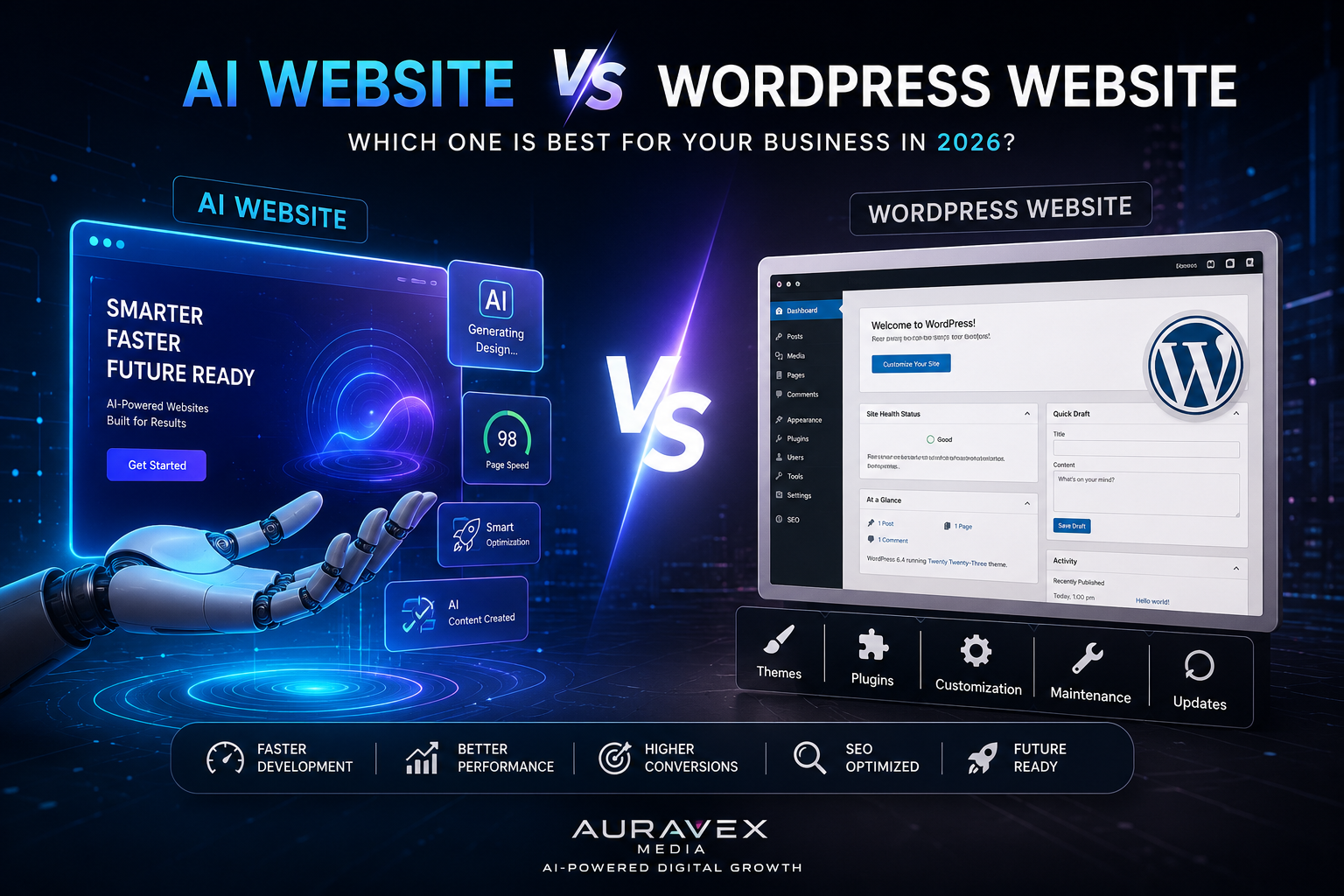
Introduction: The New Era of Business Websites
Websites have quietly become the most important asset any modern business owns. It's where people discover you, judge you, and decide whether they trust you enough to buy. And in the last two years, the way we build them has changed more than in the entire previous decade.
For a long time, WordPress was the default. It's flexible, familiar and powers a huge portion of the internet. But in 2026, a new option has taken centre stage — AI websites. Faster to build, cleaner under the hood, better optimised for Google, and dramatically easier to maintain.
So the real question isn't "AI vs WordPress" in the abstract. It's simpler: which one is actually better for your business? This guide answers that — honestly, with practical comparisons, no hype and no jargon.
What is an AI Website?
An AI website is a modern site designed, generated and optimised with the help of artificial intelligence. Instead of picking a theme and installing 30 plugins to make it behave the way you want, an AI system builds the site around your business — your offer, your audience, your goals.
What makes an AI website different
Think of it as the difference between building a car by bolting parts together and designing one from scratch around a single goal. AI websites are engineered around one outcome — results.
(Suggested image: AI Website Dashboard showing generated layouts and Core Web Vitals score.)
What is a WordPress Website?
WordPress is the world's most popular Content Management System (CMS). It powers blogs, news sites, portfolios, small business sites and ecommerce stores. You install a theme, add plugins for features you need, and manage content through an admin dashboard.
The classic WordPress stack
- CMS core — WordPress itself, updated every few weeks
- Themes — Astra, GeneratePress, Divi and hundreds more
- Page builders — Elementor, WPBakery, Beaver Builder
- Plugins — SEO (Yoast, Rank Math), forms, caching, security, backups
- Ecommerce — WooCommerce for online stores
- Hosting — shared, VPS or managed WordPress hosting
Where WordPress genuinely shines
- Content-heavy blogs and publishing sites
- Membership sites with complex user roles
- Projects that rely on a specific plugin ecosystem
- Teams already trained on the WordPress admin
Where WordPress struggles in 2026
- Page speed under real-world plugin load
- Frequent updates and plugin conflicts
- Security patches and vulnerable plugins
- Dependency on developers for even small design changes
(Suggested image: WordPress Dashboard showing plugins, updates and admin menu.)
AI Website vs WordPress: Detailed Comparison
Here's a side-by-side breakdown of how the two approaches compare across the dimensions that actually matter to a business owner.
| Feature | AI Website | WordPress |
|---|---|---|
| Development Speed | Days | Weeks to months |
| Upfront Cost | Low to moderate | Low to high (varies wildly) |
| Performance | Excellent by default | Good only with heavy tuning |
| SEO Foundation | Built-in | Depends on plugins |
| Loading Speed | Very fast | Often slow without optimisation |
| Security | Minimal attack surface | Plugin-driven vulnerabilities |
| Maintenance | Near-zero | Ongoing, monthly |
| Customisation | AI + code, unlimited | Theme + plugin limits |
| Scalability | Edge-native, scales automatically | Depends on hosting |
| User Experience | Modern, animated, refined | Depends on theme |
| Mobile Responsiveness | Mobile-first by default | Good, theme-dependent |
| Lead Generation | Optimised from day one | Requires custom work |
| AI Features | Native | Plugin-based, limited |
| Future Ready | Yes | Slower to adopt new standards |
| Developer Dependency | Low | High |
| Content Updates | Simple guided editor | WordPress admin |
| Hosting Requirements | Managed edge hosting included | Separate hosting required |
| Maintenance Cost | Low | Moderate to high |
A practical example: a service business landing page built as an AI website typically scores 95+ on PageSpeed out of the box. The same page built on WordPress with Elementor, a slider, an SEO plugin and a security plugin often lands between 55–75 — and takes weeks of tuning to catch up.
(Suggested image: Side-by-side infographic — AI vs WordPress feature comparison.)
Which Website Loads Faster?
Speed isn't just a technical metric — it's a business metric. Google's own research shows bounce rates jump by 32% when a page goes from 1s to 3s load time, and by 123% when it hits 10s. For a lead generation site, that's the difference between a full pipeline and an empty inbox.
Core Web Vitals in plain English
- LCP (Largest Contentful Paint) — how quickly the main content shows up
- INP (Interaction to Next Paint) — how snappy the site feels when clicked
- CLS (Cumulative Layout Shift) — how much the page jumps around while loading
Why AI websites win on speed
- Minimal JavaScript — only what the page actually needs
- No plugin bloat competing for resources
- Modern edge hosting close to your visitors
- Optimised images and fonts served in next-gen formats
(Suggested image: Speed Comparison graphic — PageSpeed scores side by side.)
SEO Comparison: Which Website Ranks Better?
SEO in 2026 is less about "tricks" and more about fundamentals — clean structure, great content, fast pages and clear intent. Both AI websites and WordPress can rank well, but they get there very differently.
| Feature | AI Website | WordPress |
|---|---|---|
| On-page SEO | Guided by AI, built-in | Manual, plugin-driven |
| Technical SEO | Clean code, semantic HTML | Depends on theme quality |
| Schema markup | Auto-generated | Plugin required |
| Image optimisation | Automatic (WebP/AVIF) | Plugin required |
| Internal linking | AI-suggested | Manual |
| Page experience | Fast by default | Depends on setup |
| Indexing | Instant, clean sitemap | Sometimes blocked by plugins |
| Ranking potential | High out of the box | High with heavy optimisation |
In practice, AI websites give you a strong technical baseline for free — which means your content and backlinks get to do their real job faster.
Which Website Converts Better?
Traffic without conversions is a vanity metric. The purpose of a business website is to turn strangers into leads and leads into customers. This is where AI websites pull ahead most clearly.
Why AI websites convert more
- Purpose-built landing pages — every page has one clear job
- Frictionless forms — short, smart, mobile-optimised
- Strong CTAs — placed where attention actually lives
- Trust signals — reviews, logos, guarantees baked into the layout
- Personalisation — different visitors see different offers
- Speed — every 1s faster typically lifts conversions 7–12%
A beautiful website that doesn't convert is a museum. A website that converts is a salesperson working 24/7.
Security Comparison
Website security isn't glamorous — until something breaks. Then it becomes the only thing you care about. This is another area where AI websites have a structural advantage.
| Feature | AI Website | WordPress |
|---|---|---|
| Plugin vulnerabilities | None — no plugin stack | Common — the #1 attack vector |
| Automatic updates | Managed for you | Manual or partly automated |
| Spam protection | Built-in | Plugin required |
| SSL / HTTPS | Default | Depends on host |
| Hosting security | Edge, hardened | Depends on provider |
| Admin exposure | No public login | Public /wp-admin — a known target |
Over 90% of hacked CMS sites in recent years have been WordPress installs — not because WordPress itself is insecure, but because outdated plugins and themes leave the door open. AI websites simply don't have those doors.
Maintenance: The Hidden Cost of a Website
Nobody warns you about this when you buy a website. WordPress sites need constant care — updates, backups, plugin patches, occasional breakages. It adds up, both in time and money.
| Feature | AI Website | WordPress |
|---|---|---|
| Monthly maintenance | Near-zero | 2–6 hours a month |
| Plugin conflicts | None | Common |
| Updates | Automated | Manual |
| Backups | Continuous, automatic | Plugin or host-based |
| Bug fixing | Handled by platform | Client's responsibility |
| Cost over time | Low, predictable | Rises with complexity |
Over three years, the total cost of ownership of a WordPress site is often 2–3x that of an AI website — even when the initial build cost is similar.
Cost Comparison: What Should You Actually Budget?
Prices vary widely, but here's a realistic snapshot of what businesses in India typically spend in 2026 for a professional site.
| Business Type | AI Website (Build) | WordPress (Build) | Annual Maintenance |
|---|---|---|---|
| Small Business | ₹35k – ₹75k | ₹25k – ₹80k | AI ₹6k · WP ₹18k–₹40k |
| Startup | ₹50k – ₹1.2L | ₹60k – ₹1.5L | AI ₹8k · WP ₹25k–₹50k |
| Corporate | ₹1L – ₹2.5L | ₹1.5L – ₹3L | AI ₹12k · WP ₹40k–₹80k |
| Ecommerce | ₹1.5L – ₹4L | ₹1.5L – ₹5L (WooCommerce) | AI ₹15k · WP ₹50k–₹1L |
| Enterprise | ₹3L – ₹10L+ | ₹5L – ₹15L+ | AI ₹25k+ · WP ₹1L+ |
The upfront cost of the two is comparable. The gap opens up in year two and beyond, when WordPress maintenance keeps compounding.
Best Choice for Different Businesses
Different businesses have different needs. Here's a straightforward recommendation based on the businesses we work with every day.
The pattern is clear: if your website exists to attract and convert customers, an AI website is almost always the better choice in 2026.
Is WordPress Still Worth It in 2026?
Honestly? Sometimes yes. WordPress still makes sense for:
- Large publishing operations with editorial teams already trained on it
- Membership sites relying on mature plugin ecosystems like MemberPress
- Projects with deep integrations to a specific WordPress-only tool
- Very large multi-author blogs where editorial workflow matters more than speed
But for the vast majority of business websites — lead generation, brand sites, service pages, small ecommerce, portfolios, landing pages — an AI website will be faster to build, cheaper to maintain, safer, and better at converting.
Why Businesses Are Moving Towards AI Websites
(Suggested image: Future of AI Websites illustration — a modern dashboard with automations firing.)
Common Myths About AI Websites (Debunked)
- Myth: AI websites all look the same.Reality: Modern AI stacks generate design around your brand, imagery, and goals. Two AI websites from the same builder rarely look alike.
- Myth: AI websites can't be customised.Reality: You get full design and code control. AI does 80% of the work; humans polish the last 20%.
- Myth: AI websites are bad for SEO.Reality: The opposite — they typically ship cleaner code and better Core Web Vitals than most WordPress sites.
- Myth: AI websites are only for tech startups.Reality: They work brilliantly for clinics, restaurants, manufacturers, law firms, D2C and more.
- Myth: AI websites are expensive.Reality: Upfront cost is comparable to WordPress. Total 3-year cost is usually lower.
- Myth: You can't blog on an AI website.Reality: You absolutely can — often with better editor UX than WordPress.
- Myth: AI websites can't do ecommerce.Reality: They handle products, checkout, payments and inventory — often with better speed than WooCommerce.
- Myth: AI websites are hard to update.Reality: Most offer a simple guided editor or an AI assistant. Non-technical teams can update pages in minutes.
- Myth: AI websites are just templates.Reality: They generate structure, not templates. The layout is composed around your specific business, not picked from a shelf.
- Myth: WordPress is always better because it's popular.Reality: Popularity isn't a strategy. The best tool is the one that fits your goals — not the one everyone else used in 2018.
Frequently Asked Questions
Final Verdict: Which Should Your Business Choose?
If your website exists to look pretty for a small circle of readers, either option works. If your website exists to grow your business — to bring in leads, sales and customers — the answer in 2026 is clear: an AI website gives you a stronger foundation on almost every dimension that matters.
- Faster to build and launch
- Faster load times and better Core Web Vitals
- Stronger SEO baseline
- Better security and lower attack surface
- Lower total cost of ownership
- Better lead generation and conversion out of the box
Choose based on business goals, not trends. But if the goal is growth — the choice is easy.
Explore what we can build for you: AI Website Development, Ecommerce Website Development, Business Website Design, Landing Page Development, SEO Services, Google Ads, Meta Ads, Lead Generation, and Website Maintenance.
Ready to Build a High-Converting AI Website?
At Auravex Media, we design lightning-fast AI-powered business websites that don't just look premium — they generate leads, improve SEO rankings, and help businesses grow faster. Whether you're a startup, manufacturer, exporter, ecommerce brand or service business, we'll create a website tailored to your goals. Let's build a website that's ready for the future.