
ChatGPT vs Claude for Marketing Content in 2026
Which AI assistant is better for SEO, social media and business growth? This practical, vendor-neutral comparison shows where each tool excels—and how smart marketing teams can use them without publishing generic content.
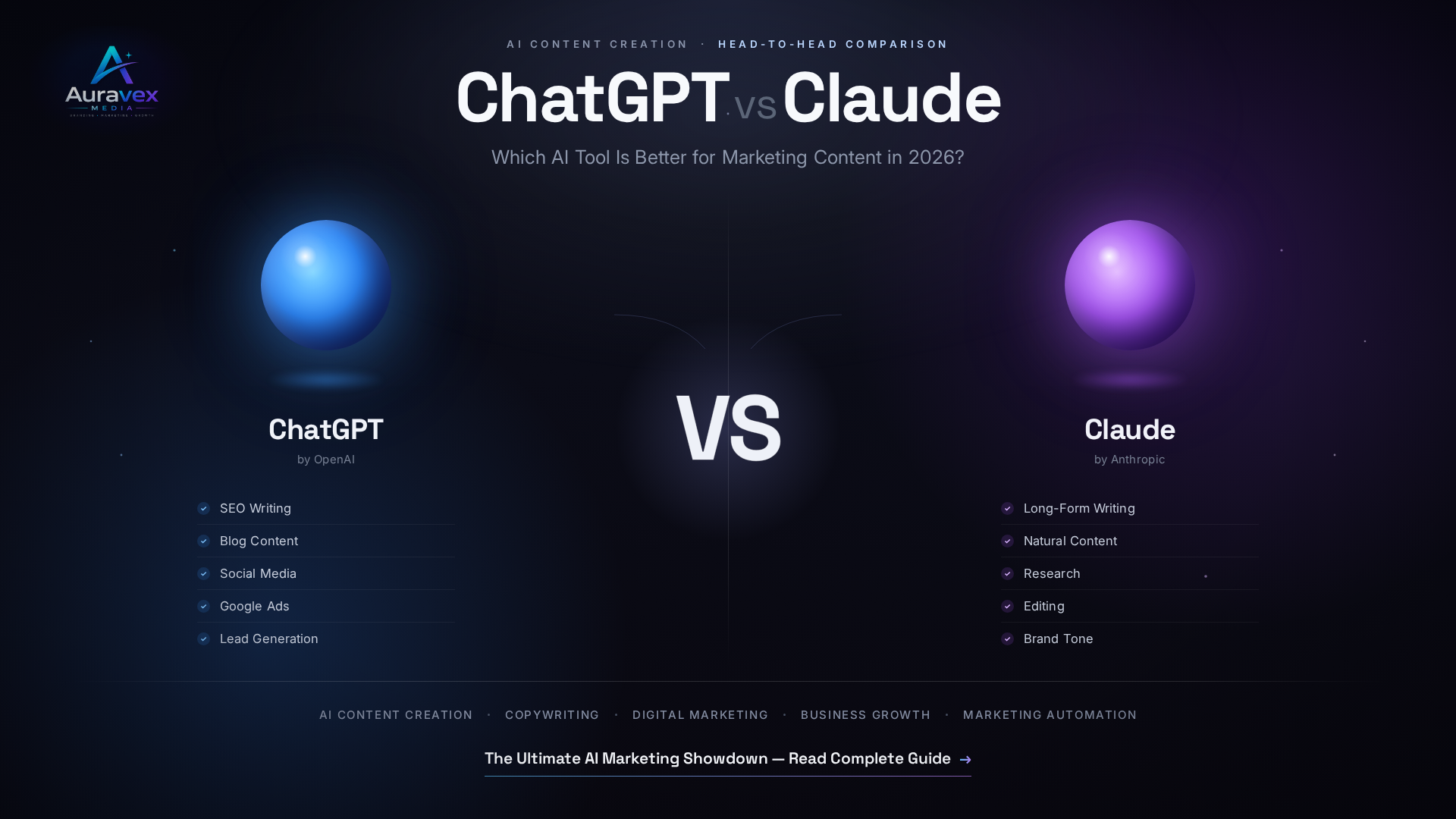
The quick answer: choose the workflow, not the winner
If you need one broad AI workspace for rapid ideation, campaign variations, multimodal tasks and repeatable marketing production, ChatGPT is the practical all-rounder. If your work starts with long interviews, research reports, brand documents or nuanced source material, Claude is often the more natural editorial partner.
That does not make one universally “better.” The models, product features, limits and pricing change quickly. More importantly, a tool that looks impressive in a blank chat can still fail inside a real marketing system. The winning setup is the one that consistently turns approved sources into distinctive, accurate work—with less editing, not merely more words.
- You need fast campaign variations
- Your workflow mixes text, files and visuals
- You want repeatable production templates
- You work from long source documents
- Voice and nuance matter more than volume
- You need a strong long-form thinking partner
ChatGPT vs Claude: marketing comparison table
The table below reflects practical workflow tendencies rather than permanent technical limits. Features vary by model, plan and region, so confirm critical capabilities in the vendors’ current documentation before standardising a team process.
| Marketing need | ChatGPT | Claude |
|---|---|---|
| Best overall use | Flexible marketing copilot | Deep reading and long-form synthesis |
| SEO workflows | Clustering, briefs, iteration | Source-led drafting, nuance |
| Social content | Fast variants and campaign concepts | Thought leadership and voice continuity |
| Long documents | Strong, depending on model and plan | A notable strength for document-heavy work |
| Multimodal ideation | Broad image and file workflows | Strong file and visual analysis workflows |
| Output style | Adaptable and action-oriented | Measured, structured and often detailed |
| Best for teams | Repeatable production systems | Research-rich editorial workflows |
What this comparison cannot decide for you
A benchmark cannot see your brand voice, approval chain, compliance requirements or customer evidence. Run a controlled trial: give both tools the same research pack, brief, audience and acceptance criteria. Blind-review the results for accuracy, specificity, structure, voice and editing time. The output that requires fewer substantive corrections is more valuable than the output that sounds exciting on first read.
Which AI is better for SEO content?
SEO content is not a typing contest. Search performance comes from satisfying intent, demonstrating genuine experience, structuring information clearly and earning trust. Both tools can accelerate the production layer; neither can manufacture authority or guarantee a ranking.
Research & clustering
ChatGPT is useful for grouping a reviewed keyword set, mapping intent and exposing overlap between proposed pages.
Source synthesis
Claude is particularly comfortable when a brief includes interviews, reports, transcripts and detailed brand context.
Editorial control
Both need fact checking, source validation, internal links and a human decision about what deserves to be published.
Where ChatGPT fits an SEO workflow
ChatGPT can help turn a strategist’s keyword research into topic clusters, page briefs, schema candidates, internal-link suggestions and alternative title angles. Its conversational iteration is convenient when a team wants to move from a rough concept to a structured production checklist. It is also useful for repurposing one approved article into snippets, outreach angles and refresh recommendations.
Where Claude fits an SEO workflow
Claude often feels strongest before and during the first draft. Give it customer interviews, subject-matter expert notes, product documentation, competitor claims and a detailed brief; it can organise the material into a coherent narrative while retaining more of the original nuance. That makes it valuable for comparison pages, guides and thought leadership where the source pack matters as much as the target phrase.
Research, positioning and business growth
The most valuable marketing use of AI may not be final copy. Both tools are powerful thinking partners when they are asked to organise evidence, challenge assumptions and expose gaps before money is spent on production or media.
Customer research synthesis
Feed an approved set of anonymised call transcripts, reviews or survey responses into a workspace. Ask the model to separate exact customer language from its interpretations, group recurring jobs and objections, and cite the source for each theme. Claude’s document-led workflow can be especially comfortable here, while ChatGPT can be effective when the analysis becomes an iterative workshop with tables, files and follow-up questions.
Positioning and offer development
An AI assistant can compare value propositions, identify unsupported claims and simulate objections from different buyer roles. It should not invent customer proof. A strong prompt asks for three outputs: what the evidence supports, what remains an assumption and what research would reduce uncertainty.
Campaign analysis
Both tools can help a marketer interpret exported campaign data, formulate hypotheses and draft a test backlog. Keep the distinction clear: a plausible explanation is not a causal conclusion. Validate recommendations against clean tracking, adequate sample sizes and the commercial context a model cannot see.
Instead of asking, “Write a campaign that will go viral,” ask: “Using only the evidence supplied, identify the three strongest audience tensions, show which source supports each one, then propose a low-cost experiment and the metric that would disprove the hypothesis.”
Three AI workflows that produce better marketing
The source-first SEO article
Build a research pack before opening the AI tool: search intent, primary sources, customer questions, expert notes, product facts, internal-link targets and claims that must not be made. Use Claude or ChatGPT to identify gaps, create the brief and draft one section at a time. A human editor then verifies every factual statement, adds original experience and improves the argument.
The one-to-many campaign system
Start with one approved pillar asset—a webinar, interview, report or product launch. Use ChatGPT to map the core ideas into a four-week channel plan. Use Claude to develop the longer thought-leadership pieces from the source. Return to ChatGPT for variants, production notes and concise adaptations. Review the complete set together so the brand does not repeat the same opening every day.
The two-model editorial review
Draft in one tool and critique in the other. The reviewer should not rewrite immediately; ask it to flag vague claims, missing evidence, repetition, likely reader objections and passages that could belong to any brand. The editor decides which criticism is valid, revises the piece and performs a final factual and legal review.
Prompt templates for marketers
Good prompts are compact briefs, not magic spells. They define the audience, evidence, task, boundaries and acceptance criteria. Adapt these templates with real information from your business.
You are supporting an SEO strategist. Using only the source pack below, create a content brief for [topic] aimed at [audience and intent]. Separate verified facts from assumptions. Include the primary question, supporting questions, proposed H2s, evidence required for each section, internal-link opportunities and three ways this page can add value beyond the current search results. Do not draft the article yet. Flag missing evidence first.
Analyse the approved examples below. Describe the voice using observable patterns: sentence length, vocabulary, point of view, humour, pacing, formatting and phrases to avoid. Then rewrite the supplied draft without adding new claims. Preserve the meaning, remove generic AI phrasing and explain the five most important edits.
Turn this approved article into a seven-post campaign for [platform]. Each post must communicate a different idea, open with a specific observation rather than clickbait, and end with a relevant conversation prompt. Provide a suggested format, creative direction and one measurable objective per post. Do not invent statistics or customer stories.
Review this draft as a skeptical senior editor. Do not rewrite it. Create a table with: passage, problem, why it matters and recommended action. Focus on unsupported claims, factual risk, weak transitions, duplicated ideas, search-intent gaps and language that could belong to any competitor. Rank issues by business impact.
Accuracy, privacy and the human quality gate
AI output can sound certain while being wrong. It can flatten a distinctive voice, misread a source or present a prediction as a fact. Marketing teams need a quality gate that applies regardless of which model produced the draft.
- Verify names, dates, quotations, prices, product capabilities and legal claims against primary sources.
- Keep customer data, credentials and confidential strategy out of unapproved workspaces.
- Require a human owner for every published asset and campaign decision.
- Replace generic advice with firsthand expertise, examples or clearly attributed evidence.
- Review for bias, accessibility, brand risk and local market context.
- Record the prompt, source set and approval status for repeatable high-impact workflows.
Read the current product documentation
Product capabilities and policies evolve. Before using either platform with business data, review the current OpenAI privacy information and Anthropic Privacy Center, then align your workflow with your organisation’s data policy.
Which AI tool should your business choose?
Choose ChatGPT if your priority is a versatile marketing workspace that moves quickly across ideation, production, repurposing and multimodal tasks. Choose Claude if your priority is reading deeply, handling substantial source material and developing thoughtful long-form content with a steady voice.
Choose both only when the handoff is clear: for example, Claude synthesises the research and creates the long-form draft; ChatGPT develops campaign variants and a production plan; a human editor owns the final decision. If nobody owns quality, a second model simply doubles the volume of work that needs review.
Broad coverage and fast iteration across everyday tasks.
A strong fit for research-heavy and long-form workflows.
Use a scored trial on your real campaign, not generic demos.
The durable advantage is not access to a model that competitors can also buy. It is the system around it: better customer evidence, sharper positioning, stronger creative judgment, cleaner measurement and an editorial bar that protects trust.
ChatGPT vs Claude FAQs
Is ChatGPT or Claude better for marketing content in 2026?
Neither tool wins every marketing task. ChatGPT is often the more flexible all-round workspace for ideation, multimodal work and repeatable production. Claude is especially strong when a marketer needs to analyse long source documents, preserve nuance or develop a coherent long-form draft. The best choice depends on your workflow, source material and review process.
Which AI tool is better for SEO content?
Claude is often useful for synthesising large research packs into a structured first draft, while ChatGPT is strong for keyword clustering, content operations and iterative optimisation. Neither can guarantee rankings. SEO performance still depends on search intent, original expertise, technical quality, internal linking and human editorial review.
Which is better for social media posts?
ChatGPT is usually convenient for rapidly producing platform-specific variations, hooks and campaign concepts. Claude can be a strong choice for maintaining a nuanced brand voice across longer LinkedIn posts or thought-leadership content. Test both against a clear voice guide rather than accepting the first output.
Can Google rank AI-generated content?
Google's published guidance focuses on content quality and helpfulness rather than whether AI was used. Low-value, scaled content created primarily to manipulate rankings can violate spam policies. Useful content should add original value, satisfy intent and be reviewed for accuracy.
Can ChatGPT and Claude replace a marketing team?
No. They can accelerate research, ideation, drafting, repurposing and analysis, but they do not replace customer knowledge, positioning, creative judgment, fact checking, performance measurement or accountability. The strongest model is an AI-assisted team with clear human ownership.
Should a business use both ChatGPT and Claude?
Using both can be worthwhile when content volume or complexity justifies it. A practical workflow is to use one tool for research synthesis and drafting, then the other for critique, alternatives or repurposing. Small teams should first master one tool and a documented review process before adding another subscription.
How do marketers prevent generic AI content?
Provide real source material, customer language, examples, a brand voice guide, clear exclusions and a specific point of view. Ask the model to identify missing evidence before drafting. Then replace generic claims with firsthand experience, internal data or expert commentary.
Is it safe to upload confidential marketing data to an AI tool?
Treat confidentiality as a governance decision, not a prompt-writing detail. Review the current plan's privacy and data controls, use approved business accounts, minimise sensitive data and never upload customer information, credentials or unreleased strategy without organisational approval.
Which AI is better for small businesses?
ChatGPT is often the easiest single-tool starting point for a small business because it covers a broad range of everyday tasks. Claude may be the better fit for a founder who works heavily with long reports, interviews or detailed thought leadership. The right choice is the one your team can use consistently and review responsibly.
What should marketers measure when using AI?
Measure approved output per hour, editing time, factual correction rate, organic engagement, qualified traffic, conversion contribution and content reuse. Avoid treating raw word count as productivity; faster production only matters when the work remains accurate, distinctive and commercially useful.
Turn AI tools into a real growth system
Auravex Media combines human strategy, SEO, content, social media and AI-assisted production to build marketing systems that are faster without becoming generic.
Build your AI marketing workflow
Which is better for social media marketing?
Social content rewards speed, but it punishes sameness. The risk with both tools is a feed full of polished, interchangeable advice: predictable hooks, excessive lists and conclusions that say nothing. Strong social workflows begin with a real observation, customer story, contrarian belief or campaign objective.
ChatGPT: fast campaign expansion
ChatGPT is a strong fit for a social media manager turning one campaign idea into platform-specific executions. It can generate hook families, short captions, carousel outlines, video scripts, community questions and A/B variants while following a reusable format. It is particularly useful in a live working session where the marketer keeps narrowing the angle based on feedback.
Claude: considered brand storytelling
Claude is well suited to founder-led LinkedIn content, narrative posts and editorial series developed from long conversations or interviews. When given a precise voice guide and representative examples, it can preserve a measured tone across a longer piece without forcing every idea into a loud growth-hack formula.